


Water is essential to life. It makes up around 60–70% of the human body, and every cell, tissue and organ depends on it. So here’s the real question Australians are now asking in 2026: If water makes up most of your body, how clean is the water you’re using every single day?
You drink it.
You cook with it.
You shower in it.
Your children bathe in it.
Yet most households have never paused to ask: What’s actually in my tap water?
Table of Contents
After more than 30 years in the Australian water tank and filtration industry, we’ve seen first-hand how dramatically water quality can vary from region to region.
While Australian tap water is treated to meet government safety standards, that does not necessarily mean it is free from chemicals, treatment by-products or emerging contaminants.
Today, the conversation has shifted from “Is it safe?” to: “Is this the best quality water I can provide for my family?”
Let’s break down what matters most in modern Australian homes.
From Rain to Your Tap: What Happens to Your Water?

Water begins as rain. As it falls, it can collect airborne pollutants. Once on the ground, it may pick up:
Agricultural chemicals and fertiliser residues
Natural minerals like calcium and magnesium
Runoff from roads and industrial zones
Sediment and organic matter
Before reaching your home, water is treated to remove harmful pathogens — a process essential for public health.
However, treatment can also introduce additional substances, including disinfectants and treatment by-products. This is where many modern water quality concerns begin.
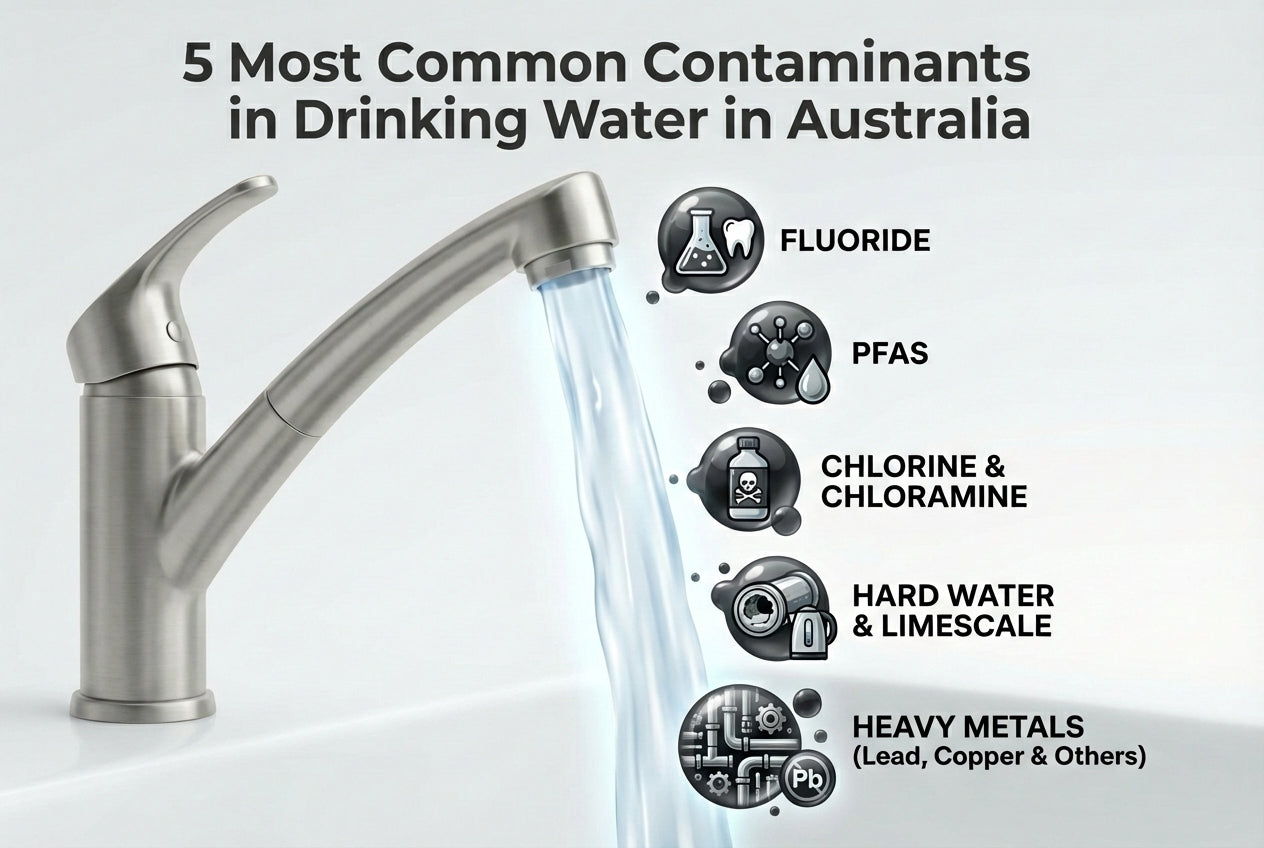
5 Contaminants in Drinking Water Australians Are Concerned About
1. Fluoride

Fluoride is added to many Australian water supplies to help reduce tooth decay. It has been endorsed by major health organisations worldwide.
However, many Australians now prefer the option of reducing fluoride intake for personal or health reasons.
While fluoridation is considered safe at regulated levels, research continues into long-term exposure and total fluoride intake from multiple sources (water, toothpaste, food and beverages). For many families, the priority isn’t debate — it’s choice.
2. PFAS & PFOS (“Forever Chemicals”)
PFAS (Per- and Polyfluoroalkyl Substances) and PFOS are often referred to as “forever chemicals” because they break down very slowly in the environment.
They’ve been used in:
Firefighting foams
Non-stick cookware manufacturing
Industrial processes
Stain-resistant coatings
In recent years, PFAS contamination has been detected in certain Australian regions, leading to tighter monitoring guidelines.
Some studies have linked high PFAS exposure to potential health concerns. As a result, many households now seek filtration systems capable of reducing PFAS levels.
3. Chlorine & Chloramine

Chlorine has been used for over 100 years to disinfect drinking water and prevent waterborne disease.
Many municipalities now use chloramine (a combination of chlorine and ammonia) because it remains stable longer in pipelines.
While effective for disinfection, some people report:
Dry skin and hair
Irritated eyes
Strong taste or odour
Sensitivity in individuals with asthma or eczema
Hot showers can release chlorine vapours into the air, which is why whole-house filtration systems are becoming increasingly popular across Australia.
4. Hard Water & Limescale

If you’ve noticed white build-up in your kettle or on shower screens, that’s limescale (calcium carbonate).
Hard water isn’t considered dangerous to drink, but it can:
Damage appliances
Leave residue on skin and hair
Cause white staining on taps and glassware
Increase electricity costs due to scale build-up
Many Australians install filtration or softening systems to improve comfort and extend appliance lifespan.
5. Heavy Metals (Lead, Copper & Others)

Heavy metals can enter water supplies through:
Old plumbing
Corroded pipes
Environmental contamination
Common examples include:
Lead
Copper
Arsenic
Although regulated, trace levels can still be present — particularly in older homes with ageing plumbing systems. Long-term exposure to elevated heavy metals is one reason many households choose certified filtration systems designed to reduce them.
Why Boiling Water Is Not Enough
Boiling water is excellent for killing bacteria and pathogens. However, boiling does not remove:
Fluoride
PFAS
Heavy metals
Chloramine
Dissolved minerals
In some cases, boiling can actually concentrate certain dissolved substances as water evaporates.
That’s why filtration — not boiling — is the solution for chemical contaminants.
What’s the Best Water Filter for Australian Homes?
The solution isn’t fear. It’s informed choice. Modern water filtration systems can be designed to reduce:
Fluoride (via specialised media or reverse osmosis)
PFAS/PFOS (with certified carbon technologies)
Chlorine and chloramine
Sediment and heavy metals
There is no one-size-fits-all water filter. The right system depends on:
Your location
Your plumbing
Whether you’re on town water or rainwater
Your specific water quality concerns
Why Australians Choose My Water Filter
At My Water Filter, we prioritise education first — products second. We help Australians choose the right filtration system for their needs, including:
What sets My Water Filter apart?
✔ Carefully selected, high-quality systems
✔ Minimum 12-month warranty
✔ FREE Australia-wide delivery
✔ 30-day money-back guarantee
✔ Phone and online support
✔ Solutions for fluoride, PFAS & chloramine reduction
We don’t sell hype. We provide solutions backed by experience and test results.
The Real Benefits of Cleaner Water

When households improve their water quality, customers commonly report:
Better tasting water
Drinking more water and fewer sugary drinks
Softer-feeling skin and hair
Improved tea and coffee flavour
Reduced chlorine odour
Less scale build-up
Easier cleaning and maintenance
Cleaner water isn’t about panic. It’s about peace of mind.
A Final Thought for 2026

You only get one body.
And water interacts with it every single day.
The question isn’t: “Is tap water legal to drink?”
The better question is: “Is this the best quality water I can provide for myself and my family?”
If the answer is no, we’re here to help.
Visit: https://mywaterfilter.com.au/
Or call 1800 769 300 to speak with our Australian-based team.
Clean water. Clear thinking. Peace of mind.
CREATE THE BEST WATER YOU CAN
Tap Water Contaminants: Even though Australian tap water meets government safety standards, it can still carry treatment by-products, ageing plumbing residue and environmental chemicals such as fluoride, PFAS ("forever chemicals"), chlorine, hard water minerals and heavy metals.
Boiling Isn't Enough: While boiling water effectively neutralises bacteria and pathogens, it does not remove chemical contaminants, heavy metals or dissolved minerals, and can even concentrate them as water evaporates.
Filtration Provides Peace of Mind: Choosing the right water filtration system—whether for the whole house or under the sink—depends on your local water quality and helps ensure better-tasting water, softer skin and hair and protected household appliances.
Hear from Our Satisfied Customers
What Are the Most Common Contaminants Found in Australian Tap Water?
The five most common contaminants and concerns in Australian tap water are fluoride, PFAS and PFOS (often called "forever chemicals"), chlorine and chloramine, hard water (calcium carbonate/limescale) and heavy metals such as lead and copper.
Does Boiling Tap Water Remove Chemical Contaminants?
No. While boiling is excellent for killing bacteria and waterborne pathogens, it does not remove chemical contaminants like fluoride, PFAS, chloramine or heavy metals. In fact, because boiling causes water to evaporate, it can actually concentrate some of these dissolved substances.
Why Should I Filter My Tap Water if It Meets Government Standards?
Government treatment ensures water is safe from immediate health threats like harmful pathogens. However, the treatment process itself can introduce chemicals like chlorine and chloramine. Additionally, water can pick up heavy metals from older plumbing systems or trace environmental chemicals. Filtration allows you to optimise the water for the best possible taste, health and household use.
What Is the Best Water Filter for an Australian Home?
There is no one-size-fits-all solution. The right water filter depends on your specific location, whether you use town water or rainwater, your plumbing, and your primary water quality concerns. Popular options include whole-house filtration systems, under-sink reverse osmosis systems and benchtop filters.
How Do I Know Which Water Filter System Is Right for My Needs?
The best way to choose a system is to identify your main concerns—such as reducing fluoride, removing chlorine odour or protecting appliances from hard water scale. Consulting with experienced providers, like our team at My Water Filter, can help you find a tailored solution that fits your specific home and local water profile.

